

Attention or attentiveness?
In English these terms are often confused or used interchangeably. Attention refers to focus at a specific moment, while attentiveness implies a more stable, lasting condition. Understanding this distinction is essential to know what can actually be measured and which aspects of attention are still hard to codify.
The difference between mere perceptual exposure and genuine engagement is central: being merely noticed is not enough to create impact, recall, or action. Attention is, in fact, a complex phenomenon influenced by perceptual, cognitive, emotional, and behavioral components, and the time spent concentrated on a stimulus is both a fundamental driver and a powerful indicator for measuring the quality of attention.
Yet, when these concepts are sought in today’s media mix, a mismatch emerges between well-established research findings and the tendency to keep validating traditional planning approaches with new vanity metrics. In the real media world, different channels offer different cost/benefit ratios to achieve a certain level of attention—and in this scenario audio plays a truly special role, because its ability to develop attentive time and therefore recall can be up to eight times greater than visual communication.
The long study on the Attention Economy, first published in 2019 and recently updated in collaboration with Lumen1, introduced attention time expressed in seconds as an indicator, and the idea of aggregating Attentive Time—that is, summing seconds of attention generated by multiple touchpoints across various media and channels. In this context, audio’s contribution and its cost-benefit relationship are unrivaled compared to other channels.
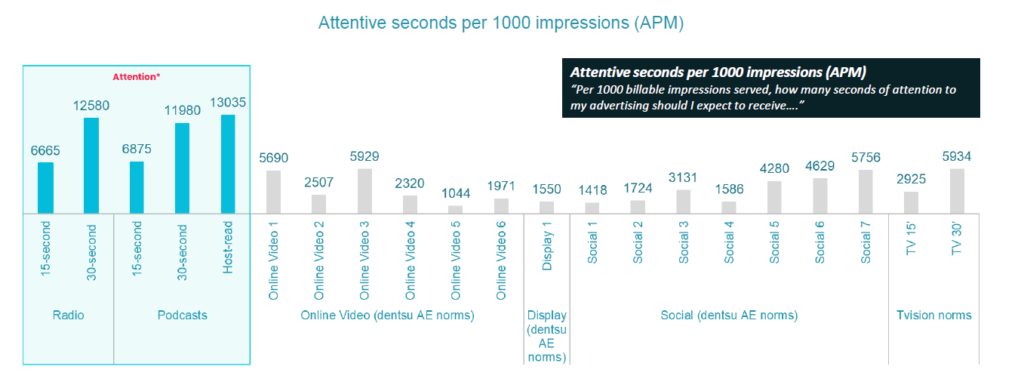
Audio generates 56% greater attentive seconds per thousand impressions than other forms of media. Some of the details of the study include Audio’s 66% greater attentiveness than Digital Video and its 155% greater attentiveness than Social Media, and the same study also found that Audio generates 8% more Brand Recall and 67% higher Brand Choice uplift versus Dentsu norms.
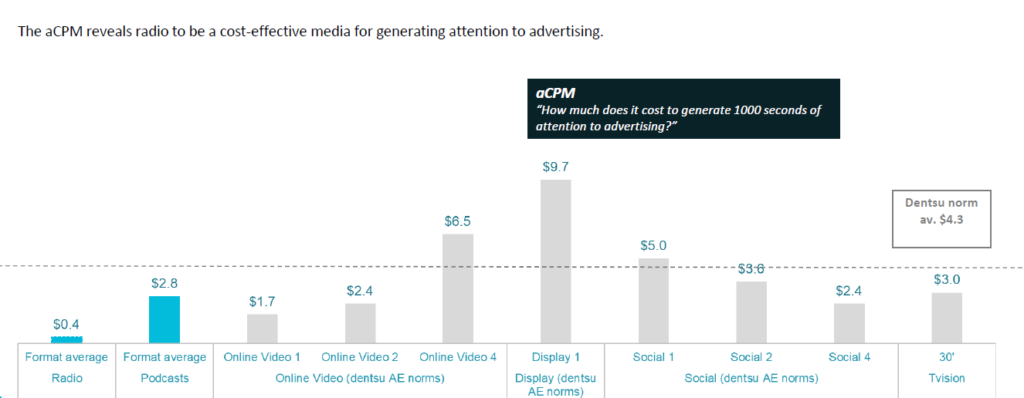
The acronym aCPM was coined to refer to the “x1000” measurement for digital purchases. Since audio is dramatically more effective than any other media but is actually less expensive, the aCPM for audio in its per-channel variations is dramatically lower than that of other channels.
Digital Audio Has Enjoyed Massive Audience & Revenue Growth but Continues to Receive Disproportionately Low Advertiser Investment2
Audio consumers are giving increasing amounts of their time and attention to audio based on the feelings of trust in and the personal importance they attach to the audio content that they consume, and this high level of engagement with audio content has led to important insights from the growing field of attention measurement about the channel’s capacity to drive brand outcomes.
In addition, to attracting more time from consumers than other forms of media such as Social Media, Digital Audio also drives tremendous engagement on social media, surpassing 1.8B engagements (total aggregate of likes, shares, reactions, and comments) across Facebook, Instagram, and TikTok from January through September 2024 alone.3
An excellent illustration of the implications of attention measurement for media planning comes from the aforementioned Neustar4 data about the relative effectiveness of ads placed in Podcasts and Streaming Audio in comparison to the most prominent Social Media platforms.
As Adelaide’s model shows, it costs marketers anywhere from 50% to nearly 170% less to secure the same level of attentiveness as it would across various social networks23, and results from the kind of campaign data used to inform attention measurement frameworks like Adelaide’s confirm the benefits of audio consumers’ high attention.
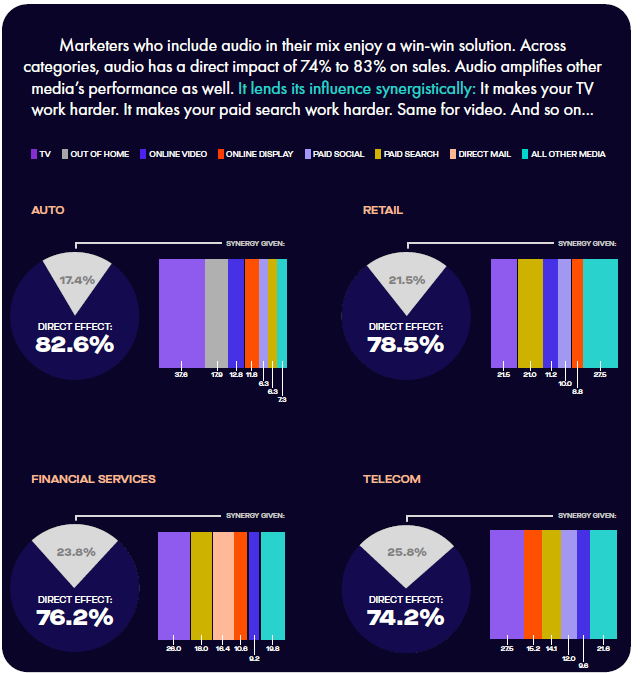
Every Channel Does Better When Audio Is on The Plan. One of the most important things to know about the importance of audio on a media plan is its ability to optimize performance across all channels of a marketing mix
So why the incident of Digital Audio in Media Mix is so unbalanced?
“There is increasing global evidence that marketers are basing their media choices on their own behavior or that stoked by the digitally obsessed marketing media, rather than actual audience data … The first law of marketing is that you are not the market. You are an urban, professional, well paid media executive. Everything you think and do is from a highly unrepresentative n of 1.5 ”
Mark Ritson, Marketing Professor
- Radio & Podcast attentiveness Study – The Economy of Attention – Lumen & Dentsu 2023 ↩︎
- Getting Audio & Podcasting on the Media Plan – USA Media Center Oct.2024 ↩︎
- Comscore Social, US** Media & Entertainment – Podcasts, Radio, Music – Music Streaming, Total Actions [FB, IG, TikTok], 1/1 – 9/24/2024 ↩︎
- Audio Amplification: The Return on Ad Spend Study, Audcacy | Neustar, May 2021 ↩︎
- Edison Research’s “Share of Ear” Q2 2025 ↩︎