YouGov’s “More than meets the ear” report measures the impact of Spoken Content ads
beyond simple listening: trust, recall and the ability to drive real action.
Spoken Content advertising has long faced an attribution problem: listeners skip ads, tune them out, or avoid them altogether, making real engagement difficult to measure. This is the starting point of the report More than meets the ear: U.S. podcast ads report 2026, produced by YouGov among more than 1,300 U.S. media consumers between March 13 and April 1, 2026. The findings describe a format that generates real advertising value even alongside low reported attention levels, with insights that extend to Spoken content in Italy and to the Spoken Article inventory distributed by Audioboost.
Skipped, and still the least annoying
Only 8% of listeners say they usually pay attention to Spoken Content ads: 52% typically skip them and another 16% do so “sometimes.” Spoken content stand out at the same time as the least annoying ad format among all those tested: only 25% of respondents find it disruptive, compared with 50% for display ads, 46% for YouTube and other video platform ads, 42% for TV and streaming video, and 36% for social media. Control over skipping clearly lowers perceived irritation, a competitive advantage for a format that operates with partial listener attention.
One of the most trusted formats in digital
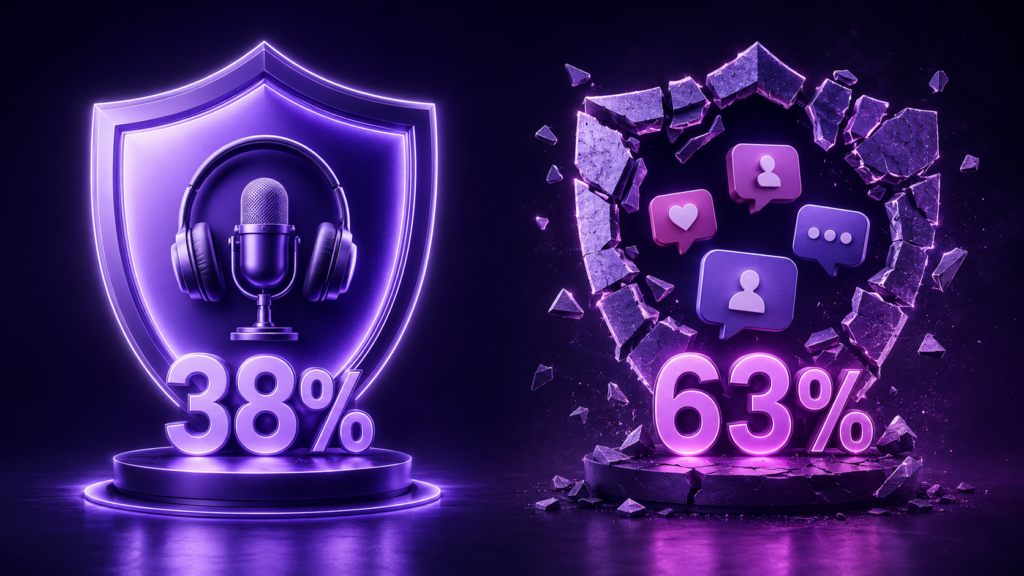
On trust, Spoken contents rank behind TV (19%) and radio (19%), ahead of YouTube (13%), display (7%) and social media (6%), with 14% of listeners saying they trust advertising in this format. The most notable figure concerns distrust: only 38% of listeners say they don’t trust Spoken content ads, compared with 48% for video platform ads and 63% for social media. Among ad formats, host-read ads remain the most credible, cited by 20% of listeners, compared with 5% for pre-recorded brand ads.
Conversion happens even among those who skip
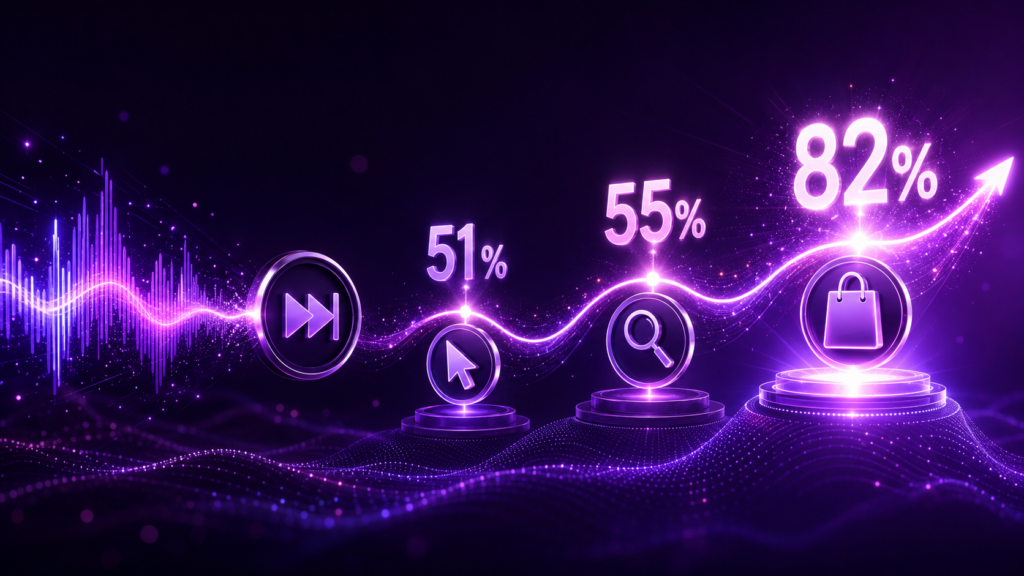
The most significant figure for advertising planners concerns conversion. 51% of media consumers took an action after hearing or seeing an ad on podcast, radio or streaming audio: 30% visited the brand’s website, 30% searched online for the brand or product, 21% talked to someone about it, and 16% made a purchase. Spoken content consumers convert at a higher rate than the average audio user: 60% took an action, compared with 54% of music streaming listeners and 53% of radio listeners. The most notable figure concerns habitual ad-skippers: 55% still took a conversion action, a share that rises to 82% among those who skip ads only occasionally. Skipping an ad, then, does not mean being unreachable.
What this means for Spoken content in Italy
The report captures the U.S. market: its figures are not directly transferable to the Italian context in absolute terms. The same study also offers a useful reference point: 56% of Italians listen to or watch Spoken content, a share close to the U.S. figure (54%) and to markets such as France and Singapore (54% each). By logical extension, the mechanisms observed in the U.S. – low reported attention alongside high conversion potential, trust levels above display and social formats, the value of natively-read ads – are consistent with what Audioboost observes across Spoken content and the Spoken Article inventory distributed through Speakup-Article™: intentional listening that drives recall and action even when reported attention is low.